I heard about this book from Dan
Pollock, an original member of the Mixtures. Although
from Ventura, California, the Mixtures were managed by
Eddie Davis and were part of the East L.A. sound and scene.
Their instrumental recording of a song called "Olive Oyl" is and Eastside classic, which is included in the
"Eastside Sound" four-volume CD set on the Varese
Sarabande label. The collection also includes their
"Rainbow Stomp (Volume One)," "Karen,"
on which they backed Little Ray Jimenez, and two other tracks
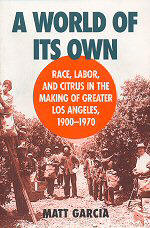
on which they are featured. The full title of the book
is "A World of Its Own- Race, Labor, and Citrus in the
Making of Greater Los Angeles, 1900-1970." It's
author is Matt Garcia and it's published by the University
of North Carolina Press (2001). The book is very academic
and intelligently written, but the scope and subject matter
of the book in its entirety is not relevant to my website.
However, there is a chapter which is totally relevant and
very interesting. It's called "Memories of El Monte-
Dance Halls and Youth Culture in Greater Los Angeles, 1950-1974."
The chapter focuses on two dance halls, El Monte Legion Stadium
and Rainbow Gardens in Pomona. These venues were quintessential
and classic places for Latin music, r&b, and Chicano "Eastside
Sound" bands. Many East L.A. and Eastside bands
played these venues in the early 60s, including me.
My teenage band, Mark & the Escorts played several times
at Rainbow Gardens in 1964, where we were on the bill with
bands such as the Romancers, the Desires, the Jaguars with
the Salas Brothers, Ronnie & the Casuals, and others.
The chapter describes the early days of Rainbow Gardens in
the 1940s when it was a big band venue. Harry James,
Les Brown, Perry Como, and many others would perform there
in the period. The book points out that there was rarely,
if ever, a brown or black person in the audience at the venue.
There may not have been a "white only" sign on Rainbow
Gardens, but that's the way it was. A local disc jockey
named Candelario Mendoza, who played Latin music of all styles
on his local radio show, suggested that Rainbow Gardens have
a Latin night. The owners gave him a chance to do it
on a weeknight. They didn't expect much of a turnout
so they only hired one security guard, one bartender, and
a couple of waitresses. Cande, as he was called, had
booked Beto Villa and to the owners' amazement there was a
line around the block for the show. They had to scurry
and get more staff to handle the crowd. When they counted
their receipts the next day, Latin night on a regular basis
was on. Cande brought in monster Latin artists such
as Tito Puente, Machito, Tito Rodriguez, Luis Alcaraz, Rene
Touzet, Tin Tan, and Perez Prado! By the mid-50s, Latin
music took over the venue. They would have rock &
roll on Friday nights, conjunto on Saturdays, and a tardeada
on Sunday afternoons. As the popularity of rock &
roll grew, Rainbow Gardens became a rock & roll venue.
The Mixtures, who were a racially mixed band as the name implies,
became the house band in the early 60s. Artists such
as Lou Rawls, Barry White, the Rivingtons, Bobby Rydell, and
the Beach Boys either opened for, or were backed by the
popular Mixtures during this period. The Mixtures were
a great live act and had a huge following. Their
records sold very well locally, but somehow did not go
national. There's a lot more information on the
Mixtures in the chapter, including names of members, and a
great photo. There are other great photos, including one of Cande
Mendoza and a great shot of Rainbow Gardens in its heyday in the
50s.
Rainbow Gardens burned down in 1965.
El Monte Legion Stadium was another hot bed of rock &
roll, r&b, and "Eastside Sound" and Chicano
bands and singers. It had originally been built for
the 1932 Los Angeles Olympics to house wrestling matches.
The audiences at the venue were racially mixed as were the
musical artists. You had blacks, whites, Latinos, and
Pacific Islanders partying together. That's not to say
there wasn't the occasional fight. East L.A.'s pioneering
band, the Romancers, were a house band there for a time.
Rosie & the Originals of "Angel Baby" fame also
performed there often. There's lots of information about
Rosie Hamlin, who had a Mexican mother and Anglo father, including
where she describes the gender discrimination that she and
other female singers endured from promoters during this era.
The book also describes the pachuco/cholo culture at El
Monte Legion Stadium. The low rider cars they drove,
the Sir Guy shirts and khakis worn by the teenage boys, the
way the girls dressed, and the social behaviors. A
very important point is brought up in the chapter that I
hadn't known or realized. That early rock & roll
promoters realized that the main market for rock & roll at
that time was the teenage market. The city of Los
Angeles had very restrictive laws against teenagers
congregating anywhere, let alone at dance venues. So
the promoters found venues in the unincorporated areas of
the county and outlying suburbs where it was possible to
have teenage dances. Aside from some night club
venues, church halls, local armory auditoriums, and high
school gymnasiums were used. This later gave rise to
the East L.A. teenage music scene of the 60s which
made the golden age of East L.A.'s "Eastside Sound"
possible. In East L.A., we had St. Alphonsus Auditorium,
the Montebello Ballroom, the Big and Little Union Halls, Kennedy
Hall, and many more. "A World of It's Own" is
published by the University of North Carolina Press. For ordering from a book store use ISBN 0-8078-4983-9.

 I heard about this book from Dan
Pollock, an original member of the Mixtures. Although
from Ventura, California, the Mixtures were managed by
Eddie Davis and were part of the East L.A. sound and scene.
Their instrumental recording of a song called "Olive Oyl" is and Eastside classic, which is included in the
"Eastside Sound" four-volume CD set on the Varese
Sarabande label. The collection also includes their
"Rainbow Stomp (Volume One)," "Karen,"
on which they backed Little Ray Jimenez, and two other tracks
on which they are featured. The full title of the book
is "A World of Its Own- Race, Labor, and Citrus in the
Making of Greater Los Angeles, 1900-1970." It's
author is Matt Garcia and it's published by the University
of North Carolina Press (2001). The book is very academic
and intelligently written, but the scope and subject matter
of the book in its entirety is not relevant to my website.
However, there is a chapter which is totally relevant and
very interesting. It's called "Memories of El Monte-
Dance Halls and Youth Culture in Greater Los Angeles, 1950-1974."
The chapter focuses on two dance halls, El Monte Legion Stadium
and Rainbow Gardens in Pomona. These venues were quintessential
and classic places for Latin music, r&b, and Chicano "Eastside
Sound" bands. Many East L.A. and Eastside bands
played these venues in the early 60s, including me.
My teenage band, Mark & the Escorts played several times
at Rainbow Gardens in 1964, where we were on the bill with
bands such as the Romancers, the Desires, the Jaguars with
the Salas Brothers, Ronnie & the Casuals, and others.
I heard about this book from Dan
Pollock, an original member of the Mixtures. Although
from Ventura, California, the Mixtures were managed by
Eddie Davis and were part of the East L.A. sound and scene.
Their instrumental recording of a song called "Olive Oyl" is and Eastside classic, which is included in the
"Eastside Sound" four-volume CD set on the Varese
Sarabande label. The collection also includes their
"Rainbow Stomp (Volume One)," "Karen,"
on which they backed Little Ray Jimenez, and two other tracks
on which they are featured. The full title of the book
is "A World of Its Own- Race, Labor, and Citrus in the
Making of Greater Los Angeles, 1900-1970." It's
author is Matt Garcia and it's published by the University
of North Carolina Press (2001). The book is very academic
and intelligently written, but the scope and subject matter
of the book in its entirety is not relevant to my website.
However, there is a chapter which is totally relevant and
very interesting. It's called "Memories of El Monte-
Dance Halls and Youth Culture in Greater Los Angeles, 1950-1974."
The chapter focuses on two dance halls, El Monte Legion Stadium
and Rainbow Gardens in Pomona. These venues were quintessential
and classic places for Latin music, r&b, and Chicano "Eastside
Sound" bands. Many East L.A. and Eastside bands
played these venues in the early 60s, including me.
My teenage band, Mark & the Escorts played several times
at Rainbow Gardens in 1964, where we were on the bill with
bands such as the Romancers, the Desires, the Jaguars with
the Salas Brothers, Ronnie & the Casuals, and others.