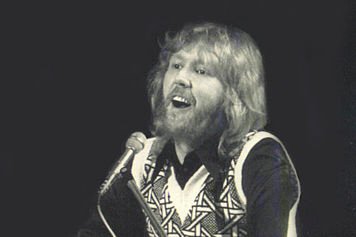
Harry Nilsson
was a phenomenal singer and songwriter who achieved his
greatest success in the early 70s. His biggest hits were
“Everybody’s Talkin’,” “Coconut,” and “Without You.” The
Beatles were big fans of Nilsson. John Lennon became good
friends with him and produced his album “Pussycats.”
Nilsson was unusual in that despite his great talent and
success, he never toured.
The year was 1979 and I had just finished a
recording session with my friend John Douglas at Gold Star
Studios in Hollywood. John and I went out in the hallway and,
lo and behold, there was Harry Nilsson on a break from his
session in another studio across the hall. I recognized him and
we struck up a conversation. He was down to earth and very
friendly. So much so that he invited John and I into his
session to hear what he was recording. It was a song called “Sweethaven,”
a song he’d written for the “Popeye” movie soundtrack. It
sounded great and what made it unique was an unusual keyboard
instrument. The man who had invented it was there and had
apparently rented it to Harry. I don’t remember the name of the
instrument, but it was the one used on the theme song for the
“Rhoda” TV series. If you remember that song, you’ll know what
the keyboard sounds like. As each note was struck, it sounded
like mallets doing trills on metallic plates. Musically, the
song was mid-tempo and to my ear had a style that was Beatlesque.
I loved it. My friend John soon left, and I stayed and watched
Nilsson overdub a tympani drum part on the song. I was
impressed with the freedom and ease of his creativity. He did
it in one take and added a new dimension to the recording. I
then watched Harry do a great lead vocal while smoking a
cigarette between phrases, which amazed me. When the official
“Popeye” soundtrack album was released, I remember being
disappointed with the new version of “Sweethaven.” The demo had
a looseness and a magic that was lost in the remake. Also,
Harry Nilsson didn’t sing on the Popeye soundtrack. It was the
actors in the movie.
The musicians present at the session were Van Dyke
Parks, best known for his work with Brian Wilson and the Beach
Boys, and Klaus Voorman, best known for his association with The
Beatles. I was particularly excited about Klaus because of his
history with the Beatles. Klaus Voorman became friends with the
Beatles in their early days in Hamburg, Germany, designed the
legendary cover of their “Revolver” album, and later played bass
on John Lennon solo albums, including “Plastic Ono Band” and
“Imagine.” My impression of Van Dyke was that he was a very
funny man with endless energy and creativity. Klaus, on the
other hand, was very serious and low key. When Harry Nilsson
got to laying down vocals on a song about Bluto entitled “I’m
Mean,” he asked me if I wanted to sing background vocals. Next
thing I knew, I was singing with Klaus Voorman and a female
vocalist. It came out well and Harry seemed to be pleased,
shaking my hand when I returned to the control room. I first
went into the session in the late afternoon and wound up staying
until about six in the morning. At one point, Harry needed a
guitar on a track and asked me if I played. I said yes, but
that my guitar was at my house about a half an hour away. He
wanted me to go get it, but at 4:00 o’clock in the morning I was
too tired by then and declined. I also felt that by the time I
got back Harry would have either already left or passed out. As
I recall, Klaus Voorman and I were among the few who remained
sober all night. Harry Nilsson was a great singer/songwriter,
but very self-destructive. Both traits were abundantly apparent
that night. In the first few hours of the session I felt
privileged to witness a musical genius at work, but by the end
of the night due to his excessive drug and alcohol intake he was
a detriment to the creative process. It was a wild and crazy
session, but memorable to say the least. Over four-decades
later, I remember it vividly. As it turned out, Harry’s
addictions put an early end to his life, but his music will live
on.