Rubén
Funkahuátl Guevara: Ruben & the Jets, Con Safos,
y Más
by Mark Guerrero
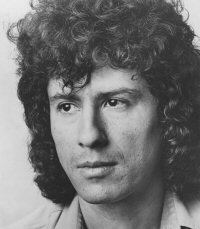
Rubén Funkahuátl Guevara is a singer, songwriter, producer,
writer, poet, performance artist, and impresario. He
made his mark in music with his 1970s band Ruben & the
Jets, who recorded two albums on the Mercury Record label,
the first produced by the legendary Frank Zappa. In
the early 80s, and again in the mid-90s, he ran Zyanya Records, a subsidiary of Rhino Records. At Zyanya,
he compiled and released three albums in the 80s and two in
the 90s, which featured Chicano rock artists, as well as rock
en Español groups from Latin America and Europe. He
has composed a rock gospel cantata, created art videos and
performance art pieces, provided music composition and coordination
for movies and television, and put together shows featuring
music and dance. He has been aptly called a culture
sculptor.
Ruben Guevara grew up in the Mexican
barrio of Santa Monica, moved to Cathedral City, then settled
in the racially mixed Pico Union district of Los Angeles,
just west of Central Avenue. His father was a singer/songwriter/musician,
who was a member of a major trio from Mexico called Los Porteños.
(The legendary Miguel Aceves Mejia was also in the group.)
Rubén Guevara Sr. came to Los Angeles to perform with Los
Porteños at an International Folk Festival at the Los Angeles
Coliseum for Cinco de Mayo in 1941. At a performance
during the same trip at the Million Dollar Theater in downtown
L.A., Rubén Guevara’s future mother and father met backstage.
Rubén Sr. left the trio and stayed in L.A. to pursue the relationship.
Ruben says his father was his first music teacher. At
age nine, Ruben took up the trumpet in school and succeeded
in playing in the California All Youth Symphony. At Berendo Jr. High School he began to be interested in rock
& roll and rhythm and blues. By the time he was
in high school he was singing in a doo wop group. In
1958, Ruben and Pablo Amarillas formed the Apollo Brothers,
who were influenced by Don & Dewey and the Carlos Brothers.
They performed at the El Monte Legion Stadium, Alan Freed’s
Record Hop at Jordan High in Watts, Pacific Ocean Park, and
various local television shows. They recorded for Cleveland
Records and were the first Chicano duo to be played as a VIP
platter on KGFJ, a Los Angeles rhythm and blues station.
At the time Ruben’s influences were: In doo wop (besides
the two previously mentioned)- Robert & Johnny, Vernon
Green & the Medallions, the Penguins, the Jaguars (South
Central L.A.), the Flamingos, Don & Juan, Ritchie Valens,
and Lil’ Julian Herrera. In jump blues- Little
Richard, Don & Dewey, Joe Houston, and the Masked Phantom
Band. In r&b- James Brown and Bobby Blue Bland.
In 1965, Ruben performed solo on
the hit national television show, Shindig. He was on
the bill with Bo Diddley, Tina Turner, and Jackie DeShannon.
Ruben opened the show in a medley with the cast, sang a solo spot,
and closed the show with Bo Diddley. Ruben’s rendition
of Bobby Blue Bland’s “Don’t Cry No More”
went over so well, the producers wanted him to replace singer
P.J. Proby, who had left the show. They also wanted
him to change his name to J.P. Moby and did so reluctantly.
The show went off the air soon after, so the name change became
a moot point. A highlight of the experience for Ruben
was Tina Turner complimenting him on his singing. In
the late 60s, Ruben went to Los Angeles City College and studied
music composition and modern composers for two years.
This education was of help when he worked with Lalo Schiffrin
on the soundtrack for Clint Eastwood’s “Coogan’s
Bluff,” in 1968, and his later work with Frank Zappa.
In 1969, Ruben went to a Frank Zappa
and the Mothers of Invention concert at the Shrine Auditorium.
Zappa had just put out a parody doo wop record called “Cruisin’
with Ruben & the Jets.” Ruben got backstage
and thanked Zappa for bringing back that kind of music and
told him his name happened to be Ruben and he sang
in that style. Two years later, Ruben went to Zappa’s
house with a friend, keyboardist Bob Harris, who had toured
with Frank. After spending hours listening to records
and talking about music, Zappa and Ruben found that they liked
much of the same music, rhythm & blues and doo wop, as
well as modern composers such as, Varese, Bartok, Stravinsky,
and Cage. Zappa asked Ruben if he’d be interested
in forming a real Ruben & the Jets. Ruben put the
band together and auditioned for Zappa, who wound up producing
their debut album on Mercury Records called “For Real.”
The album is classic doo wop and rhythm & blues.
They did covers of Chuck Berry’s “Almost Grown,”
Joe Houston’s “All Nite Long,” a soulful
version of “Dedicated To the One I Love,” which
features a great guitar solo by Frank Zappa, and “Charlena,”
which was later also covered by Los Lobos. Ruben wrote
two of the songs, “Mah Man Flash” (co-arranged
with Zappa), and “Santa Kari” and co-wrote two
others, “Sparkie” and “Spider Woman.”
Other band members wrote all the remaining songs with the
exception of a Zappa song called “If I Could Only Be
Your Love Again.” The lead singing, harmonies
and playing on the album are excellent and true to the style.
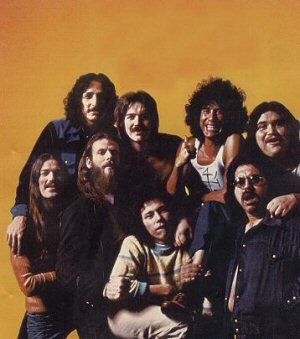
The members of Ruben & the Jets on this album were:
Rubén Guevara- vocals and keyboards, Tony Duran- lead guitar,
vocals and keyboards, Robert “Frog” Camarena-
rhythm guitar and vocals, Johnny Martinez- keyboards and vocals,
Robert “Buffalo” Roberts- tenor sax, Bill Wild-
bass and vocals, Bob Zamora- drums, and Jim “Motorhead”
Sherwood- baritone sax. (Original member, alto sax player
Clarence Matsui, left the band before recording began).
Guest musicians included George Duke and Ainsley Dunbar (formerly
a member of the English band, the Ainsley Dunbar
Retaliation). Ruben sang most of the lead vocals, but
Tony, Robert and Johnny also sang lead on the record. Ruben & the Jets
did a west coast tour with Frank Zappa in late 1972 and toured the east coast after the release of “For
Real” in ‘73. On a second tour that year,
they appeared on the bill with Three Dog Night and West, Bruce
and Lang, with T Rex included on one of the dates. Ruben
fondly remembers a particular concert at U.C. San Diego where
Ruben & the Jets were on a powerhouse bill with Malo,
Azteca, Tower of Power, and Cheech & Chong.
Ruben & the Jets recorded a second
Mercury album called “Con Safos,” produced by
Denny Randell, who had previously worked with the Four Seasons
and the Toys. “Con Safos,” which featured
the same musicians, minus Jim Sherwood, was recorded in 1973
and released in '74. Covers on this collection included,
Sam Cooke’s “You Send Me” in a medley with
the doo wop classic “A Thousand Miles Away,” Bill Dogget’s “Honky Tonk,” and Elmore James’
“Dust My Blues.” Ruben’s contribution
to the album as a writer was “Cruisin’ Down Broadway.”
After his experience with Ruben & the Jets, Ruben had
a deal to record a solo album produced by Steve Cropper of
Booker T. & the MGs, but the deal fell through. In
1975, Ruben traveled to Mexico to explore his roots, which
had a profound impact on his future musical and artistic direction.
In 1976, for the U.S. bicentennial, he recorded a doo wop
version of the “Star Spangled Banner” and “America
the Beautiful” (with ex Jet, Johnny Martinez) for Rhino
Records’ first single release. The following year,
Ruben appeared in Cheech & Chong’s first movie,
“Up In Smoke,” as a member of the band playing
the trumpet. (A closing line in the movie honored the
band when Cheech says to Chong,” we’re gonna be
bigger than Ruben & the Jets”). This began
a long association with Cheech Marin, which included writing
the title song and doing music coordination for another Cheech
& Chong movie, “Nice Dreams” and a cameo appearance
and the music coordination for Cheech’s “Born
In East L.A..”
In 1983, Ruben recorded C/S (Con Safos), a narrative piece he had written in 1975 after his
Mexican roots pilgrimage, also for Rhino Records. In
the same year, he headed Rhino’s new subsidiary, Zyanya
Records. (Zyanya is a Nahuatl word meaning always or
forever). Three albums were released: “History
of Latino Rock: 1956-65,” “The Best of Thee Midniters,”
and a compilation of early 80s Eastside bands, “Los
Angelinos: The Eastside Renaissance.” To celebrate
and promote these albums, he co-produced “The Eastside
Revue” (1983), with Brendan Mullen (founder of L.A.’s
punk mecca, The Masque) at the Club Lingerie in Hollywood.
The concert featured Cannibal & the Headhunters, Los Lobos,
Ruben & the Jets, and Con Safos, with comedian Paul Rodriguez
as MC. A second show (‘84), which I attended,
featured Thee Midniters, Thee Royal Gents, Con Safos, and
Los Perros. In 1980, Ruben formed the band Con Safos,
who were introduced by Cheech Marin for their debut at the
Whiskey in Hollywood. The members included guitarist
Danny Dias, formerly of the Village Callers, Hector Gonzalez,
bass, formerly of the Eastside Connection, John DeLuna, formerly
of El Chicano, Mel Steinberg, alto sax, and a sax player from
New Orleans, Jerome Jumonville. Ruben’s association
with Rhino/Zyanya surfaced again in the mid-90s when
he produced two CD compilations, “Reconquista, The Latin
Rock Invasion,” (4 stars in Rolling Stone), and “Ay Califas! Raza Rock of the 70s and 80s.” “Reconquista”
contained recordings by the leading bands in the alternative
rock en Español movement, including from Mexico- Maldita Vecindad,
Caifanes, Tijuana No!, Santa Sabina, Cuca, and La Castaneda,
from Argentina- Divididos, Los Fabulosos Cadillacs, from Spain- Mano Negra and Seguridad Social, and Negu Gorriak from Pais
Vasco. “Ay Califas” was a compilation of
California Chicano rock artists including Santana, Azteca,
Sapo, Malo, Tierra, El Chicano, Cheech & Chong, Los Lobos
Del Este De Los Angeles, Los Illegals,
Yaqui, the Plugz, Cruzados, Ruben & the Jets, Con Safos, Cold Blood, and Daniel Valdez.
In the early 80s, Ruben began
to write poetry for performance art projects.
In 1989, he put together the Modern Mesoamerican Ensemble,
and wrote, produced, and directed the performance art piece, “La Quemada,” which debuted at Highways Performance Space
in 1990. The same year, Ruben traveled to France with
a solo piece, “Aztlán, Babylon, Rhythm & Blues,”
which covered 500 years of Mexican/Chicano history as part
of a touring Chicano art show, “Le Demon des Anges.”
Also on the tour were artists Gilbert “Magu” Lujan
and Patssi Valdez. It was from this show that Ruben
came up with the name Funkahuátl, who was the unknown Aztec
god of funk in the “Aztlán Babylon” piece.
He began to use the name as a middle name for himself because
it reflected his love of funk/r&b and his heritage and
because he needed more humor in his life. It first appeared
professionally in 1996 as a compilation producer credit for
“Reconquista!” and “Ay Califas!.”
In 1989, Ruben was the musical director and MC for an HBO
music special called “Caliente Y Picante,” which
featured Santana, Celia Cruz, Tito Puente, Linda Ronstadt,
Ruben Blades, and Jerry Garcia. In the early 90s
at the age of 50, Ruben returned to school and got a bachelor’s
degree in World Arts and Cultures from U.C.L.A. This
provided additional building blocks of knowledge and inspiration
for his multicultural arts odyssey. For his work building
bridges between Chicanos and Mexicanos, in 2000 Ruben received
a Rockefeller U.S./Mexico Fund for Culture award to produce
“Mexamerica” (Angelino Records), a collaborative
CD with musical, visual, and spoken word artists from Mexico
City, Tijuana, and East L.A. His writings include, “View
from the Sixth Street Bridge: A History of Chicano Rock”
(Parthenon, 1984), which was part of a collection of writings
on U.S. popular culture compiled and edited by Dave Marsh,
called “The Real World of Rock & Roll.”
Ruben’s jukebox installation “Chicanos Rock California:
A History (2001)” is currently in Cheech Marin’s
traveling art show “Chicano Visions/Now” at the
Smithsonian Institution (2002) and currently at the National
Hispanic Cultural Center in Albuquerque, New Mexico (2003).
Rubén Guevara has produced many live
shows throughout the years. I remember going to one
in downtown L.A. in the 80s which featured a Pre-Columbian
percussionist by the name of Luis Perez Ixoneztli with Ruben’s
band, Con Safos. In 2002, he produced Surcos Alternativos:
Alternative Grooves From Mexamerica at the Getty Center in
Los Angeles. The concert merged Aztec Ceremonial ritual
dance with electronic border music, along with Chicano consciousness
hip-hop and Afro-Chicano funk and soul. Later the same
year, Ruben was the guest curator/narrator/artistic director
for “The Eastside Revue 1932-2002: A Musical Homage
to Boyle Heights,” presented in conjunction with the
exhibit, “Boyle Heights: The Power Place,” at the
Japanese-American National Museum in downtown Los Angeles.
It featured 70 years of music from Eastside icons such as Lalo
Guerrero, Cannibal & the Headhunters, and Tierra,
80s standouts Los Illegals
and the Brat, female acoustic vocal trio, Las Tres, and newcomers Ollin, Slowrider, Lysa Flores, and poet Marisela Norte.
The show also included Jewish Klezmer by the Skip Heller Ensemble
and Japanese Chicano fusion by East L.A. Taiko. The
event, which I attended, presented an exciting living musical
history of L.A.’s first multicultural community, Boyle
Heights, (where Guevara was born), and was a fitting 60th
birthday gift and testament to his “ongoing commitment
to create, share and spread the magic and the poetry of music.”
This article is based on an audio taped telephone interview
by Mark Guerrero with Rubén Guevara on December 5, 2002.
Update
In 2010, Ruben released an album, "The Tao of Funkahuatl,"
and in 2017, his book "Confessions of a Radical Chicano Doo Wop
Singer" was published by the University of California Press.
Clickhere
to order them at amazon.com.
(left
to right- Jim "Motorhead" Sherwood,
Tony Duran, Robert "Buffalo" Roberts,
Bill Wild, Bob Zamora,
Rubén Guevara, Johnny Martinez,
and Robert "Frog" Camarena)